EPR Intelligence ·
Your 2027 invoice is being written now, mostly not by regulators
The documents that set your 2027 invoice were written in October.
Most of them were not written by regulators.
In 30 seconds
- California's plan is under review. CalRecycle has 75 days from October 13 to decide on CAA's plan; comments to CalRecycle close November 13.
- Colorado lubricant and automotive producers answer to two programs. Interchange 360's material-based dues take effect January 1, 2027, and the split is now before a federal court.
- Minnesota has two dates. Needs Assessment comments close November 13; CAA wants producers' brand lists by December 8.
- Oregon's appeal continues. NAW asked for a stay on October 16; no ruling as of November 3, and CAA still plans to invoice in January.
- Maryland silently revised its compliance guide to Rev 2. If your file holds Rev 1, replace it.
Lead Insight
Your 2027 invoice is being written now, mostly not by regulators
The principle
A producer looking for the rule that sets its 2027 packaging fees will not find one. What it will find is a plan filed by a producer responsibility organization, a fee schedule from that same organization, a dues schedule from a second organization in the same state, a needs assessment written by a consultancy, and a reimbursement methodology written by a different consultancy. Regulators sit at the end of that chain, approving or declining what is put in front of them, usually after the numbers already exist. October made that impossible to miss: of the month's documents that set or shape producer costs, almost none came from an agency.
This is not a complaint about delegation. It is a statement about where a producer's leverage is. A comment filed on a draft reaches the people doing the arithmetic. A letter sent after approval reaches people who have already signed.
What October delivered
The revised California program plan Circular Action Alliance filed with CalRecycle runs on CAA's own numbers: Resource Recycling reports a 2027 budget of $1.105 billion, down from as much as $1.87 billion in the June draft, a proposed charge on virgin plastic estimated at $100 per ton in 2027, rising to $200 per ton in 2029, and, by CalRecycle's calculation, PET and HDPE bottles, jugs and jars more than ten percentage points short of the 30% plastic recycling rate required in 2028. Those are the figures a producer's 2027 budget has to absorb, and they sit in a document CAA wrote and CalRecycle has not yet approved.
In Colorado the same pattern produced a conflict rather than a number. Interchange 360, operated by the Lubricants Packaging Management Association, moves its Colorado dues from a flat $0.56 per gallon to material-specific rates on January 1, 2027. The Auto Care Association, seeking to join the federal challenge, says its members pay CAA for secondary packaging and paper and LPMA for primary lubricant packaging on the same products. Packaging Dive, reporting from the motion, states that CAA invoiced O'Reilly more than $350,000, that O'Reilly expects LPMA fees above $500,000, and that AutoZone has paid more than $575,000 to the two organizations in Colorado.
When two programs each bill a different part of one product, reconciling the two is a cost the producer carries.
Why this matters together
A producer that tracks only rulemakings will see a quiet autumn in five of seven states. A producer that tracks documents will see its 2027 invoices in California and Colorado set inside one month. The difference is whether anyone read the drafts while they could still be changed.
What producers should do now
- Comment to CalRecycle by November 13 if the plan's fee architecture reaches your materials.
- Check whether two programs cover different parts of your packaging. If any part of your product is lubricants or automotive chemicals, map each component to the organization that bills it and reconcile pounds against gallons before January.
- Budget for January invoices regardless of the Oregon appeal. A stay motion is not a stay, and CAA's published schedules invoice half of 2027 fees in January.
Key takeaway
October's documents set near-term invoices in California and Colorado and lay the groundwork for later costs in Washington and Minnesota.
EPR Number of the Month
CalRecycle has to review CAA's California program plan, counted from October 13, 2026.
CAA's October 23 newsletter puts the decision at December 28; CalRecycle's own page gives no calendar date.
What Changed This Month
State updates
October moved California from consultation into formal review, turned Colorado's constitutional case into a fight over how packaging is split between two programs, and gave Oregon an appellate calendar. Washington published the document its future fees will rest on. Maryland reissued its guide without saying so. Minnesota held its comment window open. Maine sent a revised RFP to state procurement.
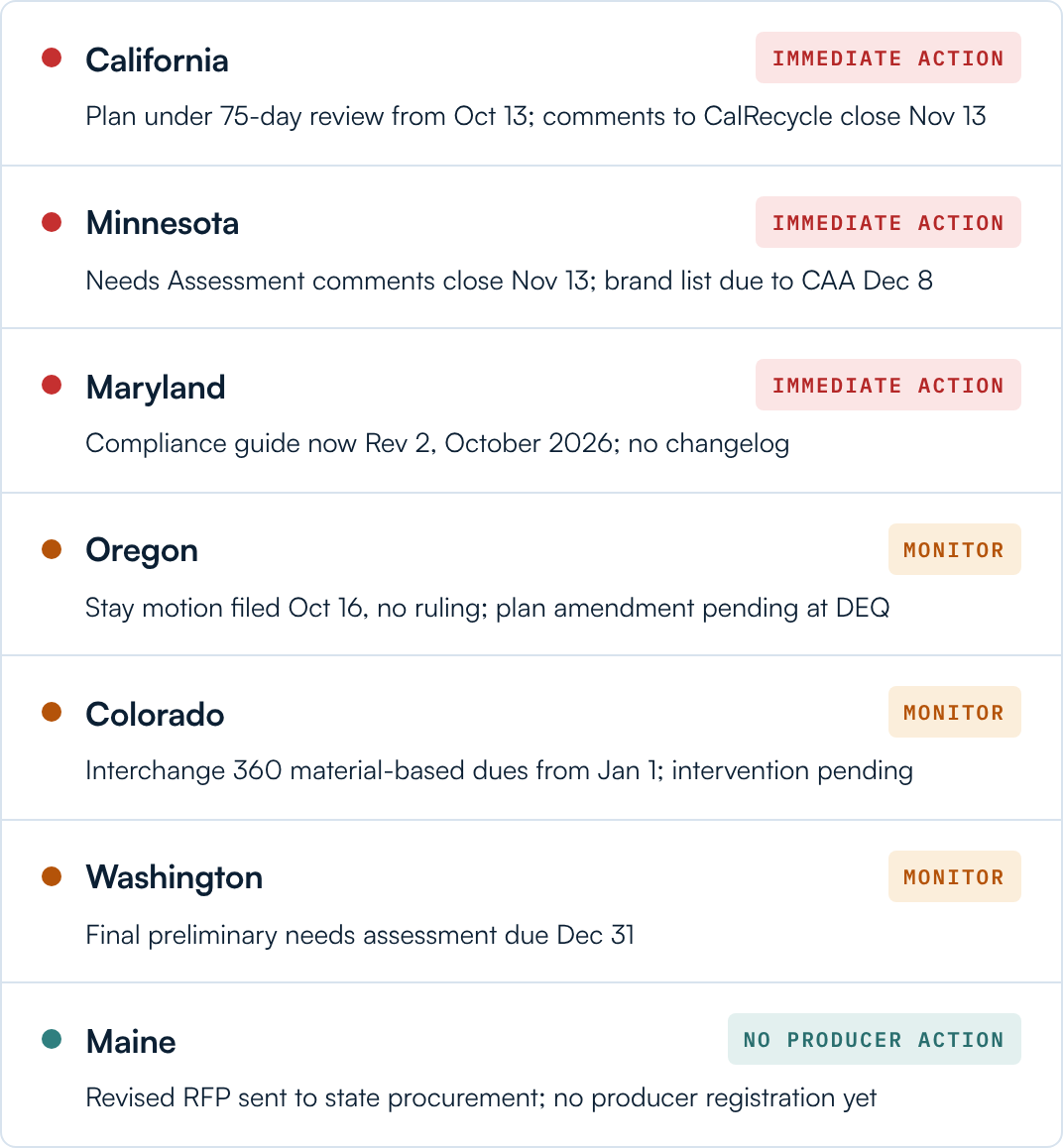
Each state below is tagged for what it requires of you this month: Immediate action · Monitor · No producer action
California
IMMEDIATE ACTIONWhat happened
- CAA submitted its revised California program plan to CalRecycle on October 13. CalRecycle confirmed receipt on its SB 54 page and stated it has 75 days to review the plan for compliance under 14 CCR 18980.6.1(b)(2). No calendar date for the decision has been published.
- CalRecycle opened public comment on the submitted plan, due November 13, by email to [email protected] with the subject line "PRO Plan Comments."
- The statutory advisory board must review a submitted plan and provide written comments within 60 calendar days of receiving it, under PRC 42070(h). The board met October 16; its materials are hosted outside CalRecycle's site and its output could not be confirmed here. The next meeting is November 6, 10 a.m. Pacific, CalEPA headquarters in Sacramento.
- CAA's California consultation on the Reimbursement Application closes November 3; the one on the Data Sharing Agreement is open to November 17.
- CalRecycle's de minimis components exclusion database and Local Jurisdiction and Recycling Service Provider guidance are now live. The public list of approved food and agricultural commodity packaging exclusions, promised under the August 27 guidance, is still marked "Coming Soon."
Why it matters — After approval, the fee architecture in that document becomes the thing your 2027 invoices are calculated from.
Action — Read the submitted plan and Appendix C–D against your own materials before you comment.
Minnesota
IMMEDIATE ACTIONWhat happened
- MPCA's draft 2026 Needs Assessment closes for comment on November 13, confirmed on MPCA's comment page. The assessment was prepared by Eunomia Research & Consulting.
- CAA has set December 8 as the date by which producers obligated in Minnesota must give it a list of their brands, to appear on the producer list in CAA's 2027 PRO registration to MPCA. CAA directs producers to submit the list through its Producer Portal (CAA newsletter, October 23).
- MPCA has posted a compilation of public comments received as of October 15 alongside the draft and its appendices.
- The packaging EPR advisory board met October 22. The September 16 meeting summary in its packet records MPCA's view that it cannot substantially rework major modeling before the statutory December 31, 2026 deadline, and that any extension would need to be substantial.
- The rulemaking timetable has slipped into view. The same summary reports that the request for comments closed July 24, 2026 with 63 comments, that the request was only the conceptual stage, that the finalized Needs Assessment will inform rulemaking, and that MPCA does not expect a Notice of Intent to Adopt until mid-to-late 2027.
Why it matters — The reimbursement methodology inside the draft is the cost base for a program under which service providers must be reimbursed at least 50% of net cost by February 1, 2029. MPCA has effectively said the December 31 deadline will hold, which makes November 13 the practical end of influence on the version that feeds rulemaking.
Action — Comment by November 13 if your material categories are unusual or your collection story is poorly represented in the baseline. Log in to CAA's Producer Portal and enter your brands by December 8. Record the mid-to-late 2027 Notice of Intent expectation in your Minnesota file: it is the first realistic marker for when Minnesota obligations acquire operative detail.
Maryland
IMMEDIATE ACTIONWhat happened
- The MDE Producer Responsibility Compliance Guide for COMAR 26.04.14 is now marked Rev 2, October 2026, in the footer of the live PDF. MDE published no announcement, no posting date and no changelog, and hosts no separate FAQ document — the FAQs are inside the guide.
- Because MDE publishes no diff, what changed between Rev 1 (September 2026) and Rev 2 could not be established here.
- No new COMAR 26.04.14 rulemaking action. The cycle completed with a Notice of Final Action on May 15, 2026. A Phase 2 regulation at 26.04.15 exists only as a February 2026 draft guidance document and has never been proposed.
- The Producer Responsibility Advisory Council last met September 10; no October meeting is listed and no next date is posted.
Why it matters — Maryland's de minimis test uses alternative thresholds: a producer qualifies if it introduced less than 1 ton of covered material into the State or earned less than $2,000,000 in global gross revenue. The "or" is the operative word.
Action — Download Rev 2 and diff it against your copy rather than assuming the dates carried over. Re-confirm the de minimis limb you rely on, in writing, with the date of the version you read.
Oregon
MONITORWhat happened
- NAW moved in the district court on October 16 to stay the judgment pending appeal, according to Keller & Heckman and the EPR Atlas docket tracker. The motion asks Judge Simon to restore its members' protection from Recycling Modernization Act fees while the appeal runs; relief would likely reach only companies that were NAW members when the February 6, 2026 injunction issued. No ruling has been reported as of November 3.
- According to the EPR Atlas docket tracker, the Ninth Circuit docketed the appeal as No. 26-6404 on September 30 and issued a schedule: mediation questionnaire October 5, transcript order October 8, corporate disclosure statements October 14, transcript November 9, appellant's opening brief December 17, 2026 and answering brief January 18, 2027.
- DEQ's third RMA rulemaking comment period closed at 4 p.m. on October 30, with hearings held October 20 and 21. DEQ's notice of September 21 states it expects to bring the rules to the Environmental Quality Commission on or after January 14, 2027; the rulemaking page says January or February 2027. No hearing summary or testimony list has been posted.
- Comments on CAA's third Oregon program plan amendment closed October 19. DEQ has taken no action, published no decision timeline and published no compilation of comments. Under ORS 459A.881 it may approve, approve with conditions or reject, with Oregon Recycling System Advisory Council review in the process.
- CAA's cover letter for that amendment, dated September 1, states it needs the covered material category changes approved by December 2026 so the producer portal can be adjusted before 2027 reporting opens.
- CAA updated its RMA Q2 2026 Producer Status Report on October 13.
Why it matters — Oregon has no producer deadline in November and two pending decisions with no dates: a stay motion in the district court and a plan amendment at DEQ. CAA has published a need-by date of December 2026 for the category changes; DEQ has published nothing. That gap decides whether 2027 reporting runs on the current categories or new ones.
Action — Nothing to file. Budget on the assumption that January invoices issue. Note which of your SKUs sit in categories the amendment touches and keep the 2026 mapping on file against a late approval.
Colorado
MONITORWhat happened
- The Auto Care Association moved on October 15 to intervene as a plaintiff in the federal challenge to Colorado's program. The proposed complaint pleads unconstitutional conditions, dormant Commerce Clause, compelled speech and association, and unlawful delegation to private parties, and argues that CDPHE exceeded the statute by approving LPMA's individual program plan and requiring members to report to two organizations, when Colorado's rules allow only one PRO until 2029. The court has not ruled on intervention.
- The association's grievance is two parallel systems for one product: at CDPHE's direction, primary packaging is reported to LPMA and secondary packaging and paper to CAA, each with its own registration, portal, fee schedule and unit. The motion says there is "no apparent coordination" between them.
- Interchange 360 notified producers on October 2 of a material-based Colorado dues schedule effective January 1, 2027, replacing the flat $0.56 per gallon. Base rates per gallon run from $0.76 for non-petroleum HDPE to $1.88 for PET, PVC, PP and other rigid plastic, plus eco-modulation factors, with back dues stated for periods from July 1, 2024.
- The state moved to dismiss the NAW case on October 13, according to the EPR Atlas docket tracker. No ruling on NAW's preliminary injunction motion has been reported; the same tracker shows briefing on it closed September 28.
- The Producer Responsibility Advisory Board next meets November 18 and December 9.
Why it matters — For producers outside the lubricants scope nothing has changed. For those inside it, the January 2027 cost base changed in October, and whether splitting one product between two organizations is lawful is now before a federal court.
Action — If any part of your Colorado volume is lubricants, automotive chemicals or their packaging, model both schedules side by side before January. Everyone else: watch for a ruling on either motion. No filing this month.
Washington
MONITORWhat happened
- Ecology took comment on the Draft Preliminary Needs Assessment from October 1 to October 30. It was prepared by a consultant team led by Eastern Research Group.
- The final preliminary needs assessment remains due December 31, 2026. The draft full assessment goes out for comment in September 2027 and the final is due December 31, 2027.
- CAA expects Ecology's third pre-draft rulemaking comment period to open in mid-November, and says rulemaking meeting #3 is scheduled for December 3, 10 a.m.–1 p.m. Pacific (CAA newsletter, October 23). The formal track is unchanged: CR-102 around October 2027, hearing around December 2027, adoption around April 2028.
- Interchange 360 began charging a Washington planning fee of $0.12 per gallon from October 1, rising to $0.25 on January 1, 2027, a new producer charge for lubricant packaging in a state whose packaging program is years from fees.
Why it matters — Washington's fees will be set from the needs assessment rather than from rule text, which makes the December 31 document more consequential for producers than the rulemaking that follows it. Ecology says producers will cover most recycling system costs beginning in 2030.
Action — No filing. Read the final assessment when it publishes and check how your material types are described in the end-market section, because that description is what later fee categories will be argued from.
Maine
NO PRODUCER ACTIONWhat happened
- Maine DEP's October 28 bulletin says the revised Request for Proposals for the Stewardship Organization has gone to the Office of State Procurement for review and posting. DEP met organizations that had declined to bid on the first RFP and changed it in response. It will not publish a new implementation timeline until a contract is signed.
- No municipal reimbursements for material recycled in 2025 and 2026, because the Stewardship Fund and producer reporting and invoicing do not exist yet. DEP expects producer guidance soon and says it will publish newsletters at least monthly.
- There is still no system for registering as a producer or claiming an exemption. Producers must register within 90 days of the stewardship organization opening start-up registration; the first annual registration and report is expected about a year after that. Chapter 428 is otherwise unchanged, including the §9(B) presumption that packaging is received by the consumer unless the producer can verify otherwise.
Why it matters, and what to do — Maine has moved from silence to a sequence: RFP posting, award, contract, start-up registration. The producer clock starts only at the last of those. Nothing to file, and an unbuilt program is still not an exemption: if your eventual Maine figure will exclude unsold stock returned unopened, preserve the documentary verification Chapter 428 requires while the transaction records are live.
Upcoming Deadlines
The full deadline calendar
Dates run through January 2027.
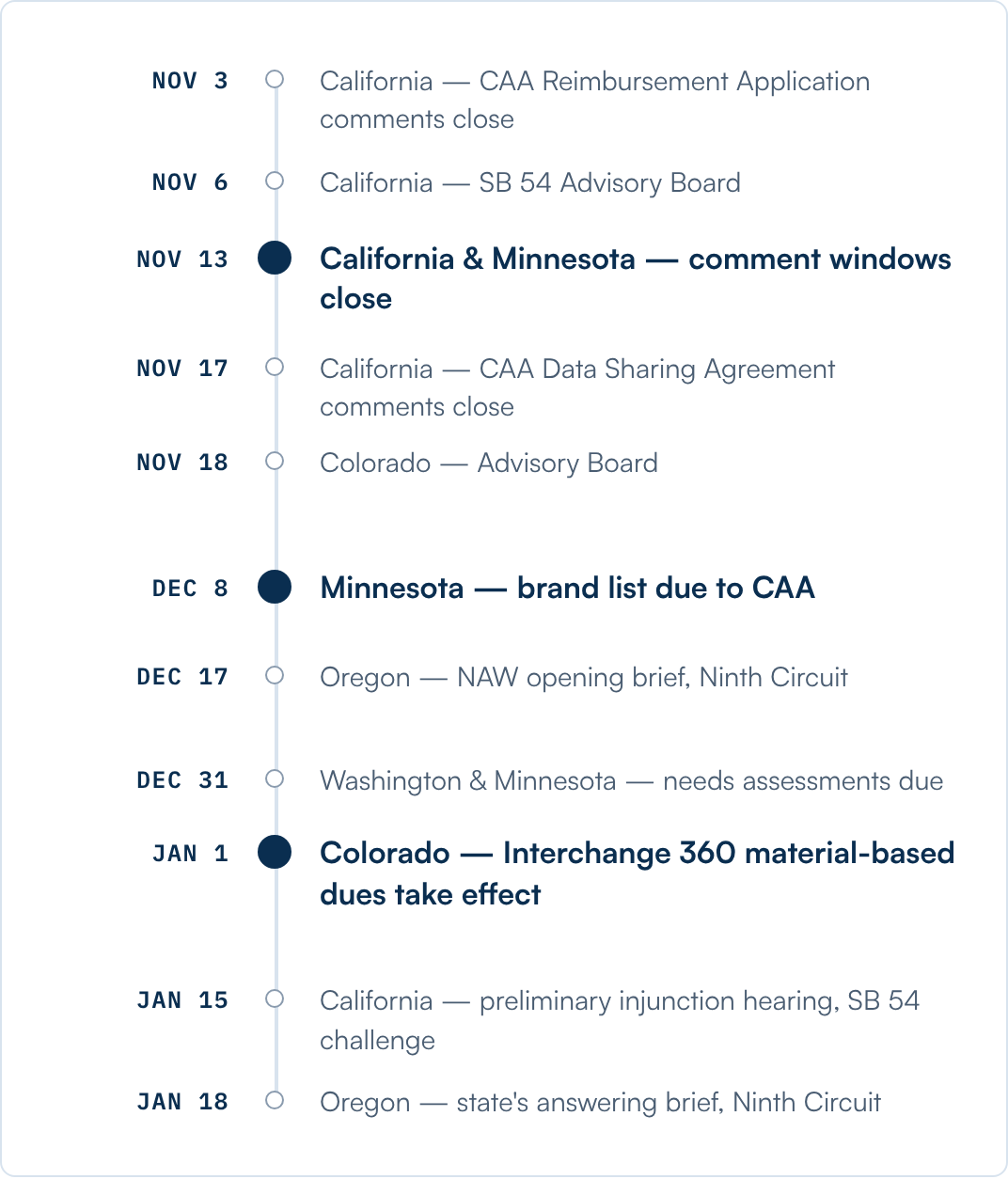
| Date | Requirement | Applies to | Type |
|---|---|---|---|
| This month | |||
| California — Comments close on CAA's draft Reimbursement Application | SB 54 producers | Consultation | |
| California — SB 54 Advisory Board meeting, CalEPA HQ Sacramento, 10 a.m. Pacific | SB 54 producers | Watch | |
| California — Comments due to CalRecycle on CAA's submitted program plan, [email protected], subject "PRO Plan Comments" | All SB 54 producers | Consultation | |
| Minnesota — Comments close on MPCA's draft 2026 Needs Assessment, including the service provider reimbursement methodology | Minnesota producers | Consultation | |
| California — Comments close on CAA's draft Data Sharing Agreement | SB 54 producers | Consultation | |
| Colorado — Producer Responsibility Advisory Board, 12:30–2:30 p.m. | Colorado producers | Watch | |
| December | |||
| Minnesota — Brand list due to CAA in the Producer Portal, for CAA's 2027 PRO registration to MPCA (deadline set by CAA) | Producers obligated in Minnesota | Mandatory | |
| Colorado — Producer Responsibility Advisory Board, 12:30–2:30 p.m. | Colorado producers | Watch | |
| Oregon — NAW's opening brief due, Ninth Circuit No. 26-6404 | Oregon producers | Watch | |
| Washington — Ecology final preliminary needs assessment due | Fee-basis input | Watch | |
| Minnesota — Final Needs Assessment due | Fee-basis input | Watch | |
| January 2027 | |||
| California, Colorado, Oregon — CAA invoices the first half of 2027 fees and dues; California's rates remain preliminary until the plan is approved | Producers in those states | Mandatory | |
| Colorado — Interchange 360 material-based dues take effect, replacing the flat per-gallon rate | Lubricant packaging producers | Mandatory | |
| Oregon — EQC consideration of the third RMA rulemaking expected on or after this date | Oregon producers | Watch | |
| California — Preliminary injunction hearing, 1:30 p.m., in the 17-state and NAW challenge to SB 54 | Monitor | Watch | |
| Oregon — State's answering brief due, Ninth Circuit | Oregon producers | Watch | |
Court dates (December 17, January 15, January 18) are as reported by the EPR Atlas docket tracker; we have not seen the court orders themselves.
Type: Mandatory · Consultation · Watch. Urgency is carried by the group headings, so color means one thing only.
Removed this month: every October row has passed, including the four comment windows this briefing has tracked since September — Oregon's October 19 and October 30, California's October 24 and Washington's October 30. Dropping the dates, not the obligations.
Upgraded this month: last month's January 15 row read as a hearing the coalition had requested. The EPR Atlas docket tracker shows the hearing set for January 15, 2027 at 1:30 p.m. on the motion filed August 19. The row now states it as set.
New Guidance & Resources
The documents that decide what you report and what you pay
October produced filings and drafts rather than final rules.
California — CAA California Program Plan, submitted to CalRecycle October 13, 2026
Why read it: it carries the budget, fee architecture and eco-modulation design that 2027 California invoices will be calculated from. Appendix C–D summarizes the comments CAA received on the June draft and what it did with them.
California — CalRecycle SB 54 page
Why read it: the only published route for commenting on the plan to CalRecycle rather than to CAA. It also links the new de minimis components exclusion database and the local jurisdiction guidance.
Washington — Draft Preliminary Needs Assessment (comment period October 1–30, 2026)
Why read it: documents existing collection services, infrastructure, material flows and end markets.
Maryland — Producer Responsibility Compliance Guide and FAQs, Rev 2 (October 2026)
Why read it: explains producer obligations, exemptions and reporting under COMAR 26.04.14, with FAQs.
Colorado — Interchange 360 material-based dues, effective January 1, 2027
Why read it: a fee document from the operator of an approved individual program plan that bills alongside CAA in Colorado, with its own material categories, its own eco-modulation and a different unit of measure.
Operational Practice Watch
Two shifts worth operationalizing
One product, two programs
Colorado's split generalizes beyond lubricants: wherever two programs each bill a different component of one product, each side is billed in its own unit.
The habit worth building is a reconciliation step rather than a legal position. For each SKU that could fall under more than one program, record the component, the organization that claims it, the unit that organization reports in, and the rate applied. Convert everything to a single internal unit so the two invoices can be compared and a component billed on both sides, or on neither, is visible as a number rather than a suspicion. If the split is ever revised by a court or a rule, the producers who can show what they paid against which component are the ones who can ask for an adjustment.
Version-pin your compliance references
A guidance document can change revision without notice, as Maryland's did in October, and quietly put a producer on a superseded document.
The practice is mechanical. When a guidance document enters your file, record the URL, the revision marker as printed inside the document, the file name, and the date you downloaded it. Keep the PDF rather than the link. Re-check on a fixed cadence — quarterly is enough for most states — and when the revision marker moves, diff rather than assume. The value shows up the first time someone asks which version a decision was made against, and the answer is a date rather than a shrug.
Quote of the Month
"CalRecycle Approves Plan, Program Begins."
— Circular Action Alliance, California page, Key Milestones, listed under "On or Before Jan. 1, 2027"
Why this sentence matters
A PRO has published a date for a regulator's decision; until CalRecycle sets one, plan for January invoices on rates CAA itself calls preliminary until the plan is approved.
Orbitlex Perspective
Read the drafts, not the rules
In most of the seven states the operative document right now is a draft, a plan or a guide rather than a rule, and most of them were written by an organization that is not the regulator. That is not a reason to distrust the numbers. It is a reason to read the drafts while they are drafts and keep a dated record of which version each decision was made against.
Watchlist
What to track next
- A ruling on the Oregon stay motion — Whether the district court stays its judgment, what relief any stay covers, and which producers fall inside it.
- CalRecycle's decision on the plan — Approval, conditional approval or disapproval. Conditional approval would trigger monthly status reporting from CAA.
- The Colorado intervention and the two pending motions — Whether the Auto Care Association is admitted, and whether either NAW's preliminary injunction motion or the state's motion to dismiss is decided. A docket tracker lists oral argument on intervention for November 6; we have not seen the order itself, so the date is not carried in the calendar above.
- Maine's revised RFP — DEP sent it to the Office of State Procurement in October. Watch for the posting, then the award; producer registration follows the contract.
Does more than one program claim your packaging?
The programs are running, the plans are being approved, and in at least one state a producer now answers to two organizations, in different units of measure, for different parts of the same product. If you are unsure which of the seven states require action from you this quarter, or whether different components of your packaging fall under different programs, start with a free EPR Compliance Status Check. We map exactly what applies to you across all seven states.
Get a free EPR Compliance Status Check